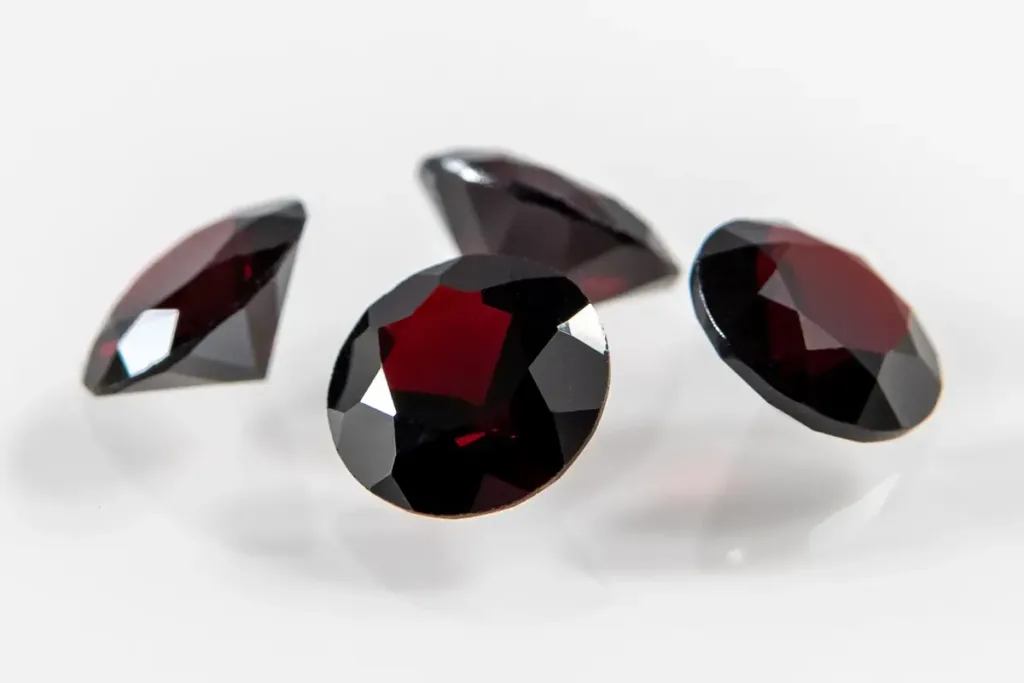

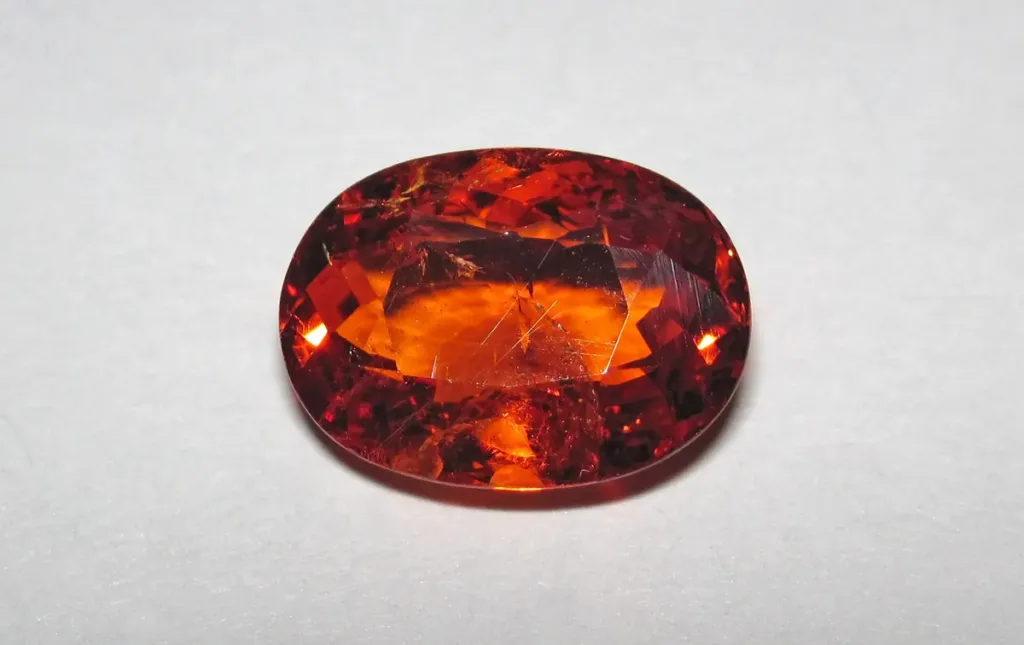
Garnet is a mineral group, not a single red gemstone wearing different labels. Its members share a crystal structure while their chemistry varies, producing reds, oranges, yellows, greens, purples, browns, and rare color-change effects.
The main garnet families you will meet
| Almandine | Usually deep red to brownish red; common, durable enough for many jewelry uses, and often darker in larger sizes. |
|---|---|
| Pyrope | Red to purplish red, sometimes with a lively open tone; much commercial red garnet is a pyrope-almandine mixture. |
| Spessartine | Orange to reddish orange, including vivid mandarin colors; inclusions and dark areas need close inspection. |
| Grossular | A wide family including green tsavorite and orange-brown hessonite, as well as pale or colorless material. |
| Andradite | Includes green demantoid and yellow to brown varieties; demantoid is prized for dispersion, though bodycolor can mask it. |
| Uvarovite | Rich green and usually seen as tiny crystals on matrix rather than as conventional faceted gems. |
Color names do not replace identity
Trade names can be useful shorthand, but chemistry in garnet is often mixed. A laboratory may use composition and spectral data to place a stone within the group. Visual appearance alone can confuse garnet with ruby, spinel, tourmaline, zircon, glass, or other materials.
How garnet behaves in jewelry
Garnet varieties generally fall around 6.5 to 7.5 on the Mohs scale. That is workable for jewelry, but not immune to abrasion. Toughness and inclusion patterns vary from stone to stone. Rings benefit from protective setting choices when a garnet has exposed corners, surface-reaching fissures, or an especially valuable finish.
Warm soapy water and a soft brush are the conservative cleaning choice. Avoid assuming that every garnet can tolerate ultrasonic or steam cleaning, particularly when a stone is fractured, included, or has an uncertain treatment history.
What to compare in a faceted garnet
- Color in daylight and ordinary indoor light
- Whether a dark red stone closes up in the center
- Windowing and face-up spread relative to carat weight
- Eye-visible inclusions and any features reaching the surface
- Abrasion along facet junctions
- Treatment and report information when the price or identity warrants it
The pleasure of the group
Garnet rewards curiosity because the familiar and the surprising sit side by side. A modest almandine can glow like a coal at the edge. A fine tsavorite can carry an intense green without the oiling questions associated with emerald. Demantoid can throw spectral fire through a green bodycolor. The name on the label starts the examination; it does not finish it.
Explore the garnet guide and the related variety pages in the gemstone information archive.