

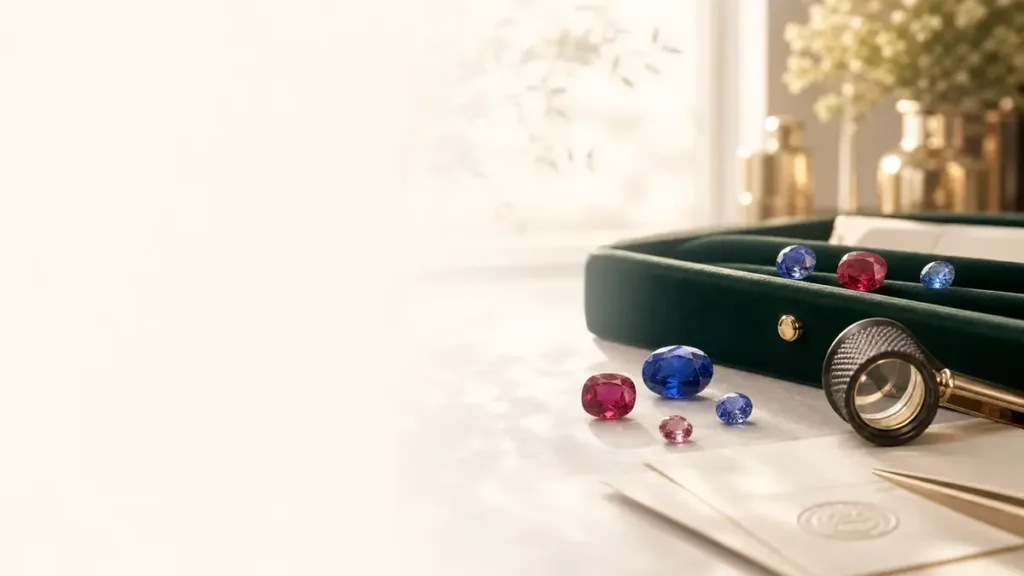
A gemstone photograph records a meeting between stone, light, camera, software, screen, and angle. Change any one of them and the color can change with it. That is why one beautiful image can introduce a gemstone but cannot settle its color.
Light changes the conversation
Daylight, a daylight-equivalent lamp, warm indoor light, and mixed shop lighting have different spectral distributions. A sapphire may look cleaner in one and greyer in another. Ruby fluorescence can become more apparent under light rich in the wavelengths that excite it. Color-change gems are defined by a meaningful shift between lighting conditions, so a single setup misses the point entirely.
Cameras make decisions
Automatic white balance tries to neutralize the scene. Exposure brightens or darkens tone. Phone software may add saturation, contrast, sharpening, or local adjustments before the image is saved. A neutral background and a familiar white or grey reference help, but they do not turn a photograph into a laboratory measurement.
Angle matters in a cut stone
Facets return different paths of light as a gemstone tilts. Pleochroic materials can show different colors or strengths of color along different crystal directions. Extinction can make areas appear black; a window can reveal the background through the center. A carefully chosen still frame may hide both.
A more useful image set
- A face-up photograph in neutral daylight or a daylight-equivalent source
- A second view in ordinary warm indoor light
- A slow, unfiltered rotation rather than a fast sparkling clip
- Side and back views that show depth, girdle condition, and inclusions
- A scale reference plus exact millimeter measurements
- A statement of any editing used beyond crop and basic exposure correction
View the images on more than one screen if color is critical. Then ask which image is closest to the seller’s naked-eye impression. The answer is subjective, but the comparison is revealing.
What photography can establish
Good photographs can show outline, symmetry, face-up spread, obvious windows, dark zones, abrasions, chips, and many visible inclusions. They cannot independently prove natural origin, treatment status, laboratory identity, geographic origin, or an exact color grade. Those claims need appropriate evidence.
Use the sapphire color guide for a deeper look at hue, tone, saturation, and evenness, or browse the current collections with these limits in mind.